
- The product of a number times an integer is a multiple of that number
- Example: 2 * 3 = 6 and 3 * 2 = 6, as a result, 6 is a multiple of 2 and 3
- 0 (zero) is a multiple of all numbers since the product of 0 times another number equals 0
- Multiples can also be negative (less than 0) since the product of a negative number times a positive number is negative
- Multiples of 2 are even numbers, 2, 4, 6, 8, 10, 12, …
- If the sum of the digits in an integer is divisible by 3, then that integer is a multiple of 3
- Multiples of 5 end with a 0 or 5
- Multiples of 10 end with a 0
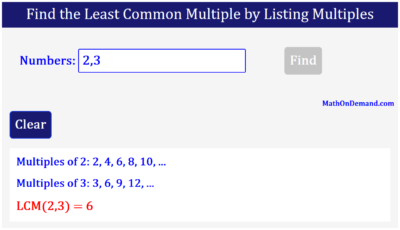
- The Least Common Multiple (LCM) of two or more numbers could be determined by listing their multiples
- Nonzero numbers have an infinite number of multiples in contrast to a finite number of factors